Automotive SPICE (ASPICE), or Automotive Software Process Improvement and Capability Determination, is not a certification checkbox. It is a structured engineering model designed to bring predictability, quality, and control to automotive software development.
Yet many organizations discover the same reality: understanding ASPICE is not the hard part. Executing it consistently, under real delivery pressure, is.
That execution gap is where Application Lifecycle Management (ALM) tools become essential. Not as compliance shortcuts, but as the mechanism that turns process intent into daily engineering practice.
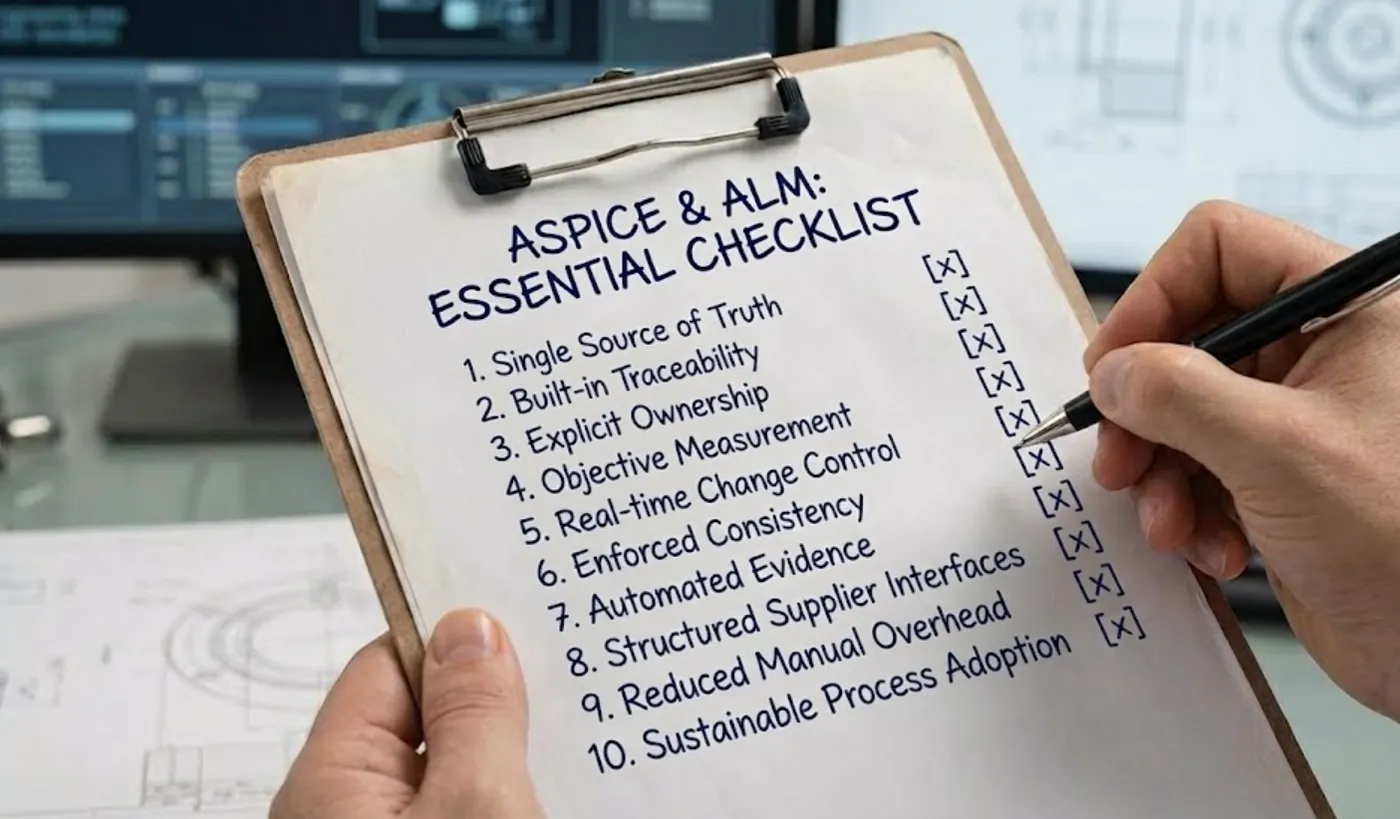
1. ASPICE Requires a Single Source of Truth
ASPICE assumes coherence across requirements, design, implementation, and verification. When these artifacts live in disconnected documents and tools, divergence is inevitable.
ALM platforms centralize work products and their relationships, ensuring that teams operate on one shared, current system view rather than parallel interpretations.
2. Traceability Must Be Built In, Not Reconstructed
ASPICE mandates bi-directional traceability across the lifecycle. Without proper tooling, teams often reconstruct links manually before assessments, under time pressure and with incomplete confidence.
ALM platforms establish traceability dynamically as work progresses. Changes propagate automatically, preserving integrity even as specifications evolve.
3. Ownership Becomes Explicit and Enforceable
ASPICE defines roles and responsibilities, but organizational silos often blur accountability in practice.
ALM tools make ownership visible: who created, reviewed, approved, or modified each work product. Missing reviews or incomplete approvals surface immediately, not weeks later during audits.
4. Progress Is Measured Objectively
ASPICE maturity cannot be assessed through slide decks or optimistic status meetings.
ALM dashboards expose real data: verification coverage, review status, open findings, and unresolved dependencies. This enables fact-based steering instead of perception-driven reporting.
5. Change Control Happens in Real Time
Automotive software programs evolve continuously. Interfaces change, features shift, and assumptions are challenged.
ALM tools make change impact explicit, showing which requirements, designs, tests, and safety artifacts are affected, allowing teams to adapt without breaking process consistency.
6. Consistency Is Enforced Across Teams and Suppliers
Without tooling, ASPICE interpretation varies between projects, sites, and partners.
Templates, workflows, and rules embedded in an ALM platform ensure that ASPICE is applied consistently, reducing variability and assessment risk across large, distributed organizations.
7. Evidence Is Generated as a Byproduct of Work
ASPICE assessments demand comprehensive evidence, but preparation should not become a parallel project.
When ASPICE is executed within an ALM environment, evidence is produced continuously: ownership logs, review histories, verification results, all audit-ready by design.
8. Supplier Interfaces Become Structured
OEM–Tier-1 boundaries are a frequent failure point in ASPICE programs.
ALM platforms support structured exchanges while preserving traceability and intent, reducing rework, friction, and misinterpretation across organizational interfaces.
9. Manual Overhead Is Reduced
Manual status updates, duplicate documents, and spreadsheet tracking erode adoption.
ALM embeds ASPICE workflows directly into daily engineering tools, reducing administrative burden and allowing engineers to focus on building and verifying software rather than managing process artifacts.
10. ASPICE Becomes Sustainable
The most important outcome: process adoption lasts.
When ASPICE is embedded into tooling, following the process becomes the default behavior, not an exception enforced by reminders. This sustainability is critical in complex, software-defined vehicle programs where delivery velocity determines program success.
From Compliance Effort to Engineering Discipline
ASPICE succeeds when it is treated as an engineering discipline, not a periodic assessment target.
ALM tools provide the structure that allows ASPICE to scale, survive change, and deliver its intended value: predictable quality in increasingly complex automotive software systems.
Used pragmatically, ALM is not bureaucracy. It is how disciplined engineering becomes repeatable.
This article reflects practical experience supporting ASPICE execution and ALM implementations in automotive and other regulated engineering environments.
Need guidance on this topic?
Our engineering teams can help you implement these strategies in your current program.
Contact Our Team